 By risaqq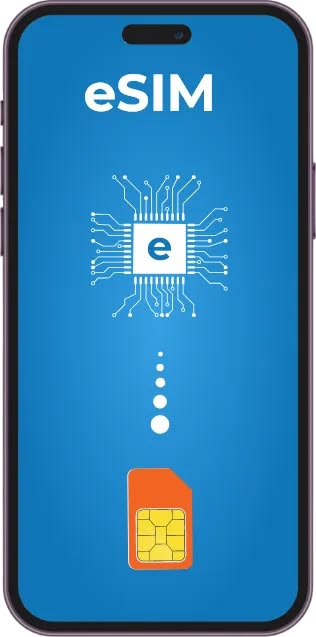
Connected with people during overseas travel is a problem travelers have long tried to solve by either locating local airport SIM card kiosks on arrival oring large monthly bills from their primary network providers for expensive roaming services. Fortunately, the new embedded SIM (eSIM) chip technology that allows travelers to download and activate cellular data plans before departure has made international travel much more convenient.
An embedded SIM (eSIM) is essentially an embedded program in a smartphone’s circuitry that enables it to connect to mobile networks through a downloadable and activatable profile. It enables overseas travelers to connect their smartphones to local carriers at their destination to avoid the hefty roaming charges their primary network providers charge when traveling abroad. However, travelers must remain mindful of some key considerations when purchasing eSIM plans for overseas use.
Firstly, they should assess their needs depending on their intended destination, duration of the stay, and overall data usage, as most international data plans charge users based on these criteria. They should also determine whether their preferred network providers are unlocked to use with a different carrier, and ensure that if they are not using the same cellular network in their destination, their cellular device is compatible with the network frequency in their intended destination.
What Is an eSIM?
An eSIM (embedded Subscriber Identity Module) is an embedded SIM card in that there is no more a physical SIM card that will have to be inserted in a sim card slot. The Subscriber Identity Module (SIM) is embedded in the phone’s motherboard. You will install eSIM profiles over WiFi rather than inserting a physical SIM card. Furthermore, they can be managed from the phone’s settings
Most profiles eSIM sold for travel purposes contain only data and not voice or text. Voice calling and SMS are generally not available on an eSIM plan unless the plan specifies that it includes them. However, you can still use messaging and voice apps that use internet data, including WhatsApp, Telegram, FaceTime, Skype, etc.
Unlike normal telecom providers who require you to come to a store and potentially show a local ID, international eSIM providers partner with telecoms around the world to provide data plans that you can purchase without any hassle
How Does a Travel eSIM Work?
Setting up a travel eSIM is a reasonably uncomplicated process that is performed digitally in a matter of minutes. Firstly, a user has to ensure their smartphone is eSIM-enabled and unlocked from their home network provider. Then, they have to choose the desired single-country, regional, or global plan on the provider’s website or application.
The profile has to be activated either through a QR code or a specific tab within the application while being connected to a stable WiFi network. Users will have to rename the primary cellular line to “Home” and the newly activated line to “Travel Data” within their smartphone’s Cellular settings and make the latter their default line for Cellular Data. The Data Roaming option will have to be turned OFF for the “Home” cellular line. Once arriving at their destination, the “Travel Data” line should be turned ON, and the Data Roaming should be activated for it to access the local cell towers.
Best eSIMs for International Travel
Comparing international travel eSIM providers involves considering several key factors in order to choose the most suitable one in accordance with the particular traveler’s route, plan flexibility, rates, and fair-use policy.
The Airalo eSIM is the best choice for inexperienced wanderers and frequent roamers since it covers more than 200 countries and provides fixed plans with data from 1 GB to 20 GB as well as global options for those who want to explore the world for around $4.5 per gigabyte. On the other hand, the only significant disadvantage of the company’s plans is the relatively high price for people who tend to stream.
The Holafly eSIM is the most appropriate solution for those who wish to enjoy an unlimited supply of data while traveling in over 190 destinations as it covers 1 – 90 day plans costing approximately $6 per day with an enhanced Fair-Use Policy. However, most of Holafly’s unlimited top-ups have a strict Fair-Use Policy and only a small percentage of them allow travelers to use mobile hotspots.
The Nomad eSIM is an excellent opportunity for budget travelers who seek flexibility since the plan offers fixed data from 1 GB to 50 GB and daily passes in 180+ destinations starting from around $4.00 per gigabyte. In addition, there is an annual option that suits frequent visitors to a specific country. The significant disadvantage of this service is that its speed depends on the particular country and the quality of a local partner.
The Saily eSIM is a perfect travel SIM card for those who prioritize security as it is a sister brand of the renowned NordVPN. The product offers a data range from 1 GB to 20 GB in 180+ destinations with plans from $3.99 per gigabyte. Nonetheless, it is a relatively new player on the market, which is why there are fewer data plan options for extreme and rural locations.
The Ubigi eSIM is an appropriate international travel plan for frequent flyers since it can be used not only in a smartphone but also in tablets and laptops. In addition, there are various flexible options, such as fixed, monthly, and annual plans, which start from $3 per gigabyte in 200+ destinations. However, a relatively complex interface may confuse some users not familiar with tech gadgets.
Best eSIM for Different Types of Travelers
For short trips (3-7 days), entry-level fixed packages (1 GB to 3 GB) start at around $4.00 from Airalo or Saily. These are the most cost-effective if you do not want to waste money on unused data. For long-term travelers, who intend to stay in the country for around 30-90 days, 20 GB to 50 GB blocks or recurring monthly renews from Ubigi and Nomad can be a more cost-effective solution than having to constantly renew digital profiles.
For heavy data users, who constantly stream media and work online, it may be worth investing in high-end or unlimited data plans (Holafly) and monitoring daily speed reduction thresholds. On the other hand, light users should calculate the cost per GB for fixed deposits (e.g., 10 GB for 30 days) and compare them to the price of an unlimited deposit to find the most cost-effective plan. Individuals who constantly cross borders between countries would benefit from considering a regional profile (Airalo) as an option, which changes cellular networks at borders automatically without requiring any extra configuration. Business travelers might want to consider the Ubigi plan for multi-network roaming and desktop/tablet provisioning. Families should either purchase separate eSIMs for every device they bring along or select a plan that allows for tethering.
Regional eSIM Options
Buying the regional plan is more convenient than buying several options in several neighboring EU countries.
The European region comprises 30-40 EU and Schengen Area countries, but it is essential to clarify if the UK, Switzerland, Turkey, and Albania are included or not. The European region consists of 30-40 EU and Schengen Area countries; however, it is essential to clarify whether the UK, Switzerland, Albania, and Turkey are included or not. North American regional carriers also comprise the countries of the US, Mexico, Canada; however, it is necessary to check if local operators provide reliable coverage in the target country. Asian regional options comprise Japan, South Korea, Thailand, Singapore; however, it is essential to clarify if South Asian countries are included in the plan. Middle East regional carriers cover the UAE, Saudi Arabia, other Gulf States; however, it is vital to remember that local laws might prohibit VoIP (Voice over Internet Protocol) which means making calls via third-party software. Finally, African regional carriers cover South Africa, Egypt, Morocco, Kenya, and many other developing countries with huge rural regions meaning that a traveler has to rely on local operators.
eSIM vs. Physical SIM Card
An eSIM profile is downloaded digitally via an app or QR code scanning, however a physical SIM card is mechanically installed into a phone tray. With an eSIM, switching operators is a matter of toggling profiles through an app, whereas with a physical SIM you have to manually hot-swap small plastic cards with a risk of losing or breaking them.
Physical SIM cards are fully supported across all major GSM hardware and can be bought for cash at any local network provider, however with eSIM you can store 5-8 virtual profiles on newer devices and eliminate any risk of losing or damaging a physical card
eSIM vs. International Roaming
International roaming enables your primary phone line to connect to foreign towers using your home carrier account. While carrier roaming is convenient as it lets your main phone number remain active for calls and 2FA security texts, it can be extremely expensive through either pay-as-you-go rates or daily passes (about $10-$15/day). A travel eSIM provides low-cost local data access while keeping your primary line active strictly for critical incoming texts with data roaming disabled on that line.